
Grief: Love with Nowhere to Land
A New Map for Honoring Your Losses and Finding Your Way Forward
“Grief is love with no place to go.” - Jamie Anderson
What do I do with love - and meaning - that has nowhere to go?
Grief is the ache of absence. It’s not only about losing people we love, but also anything we were deeply attached to – like the future we imagined, the role that gave us purpose, the beliefs that shaped our world, or the health that allowed us to move freely. It's that deep ache we feel when a child leaves home, a community dissolves, a career suddenly ends, or we wake up one day realizing we're no longer the person we once were.
No matter how much we try to avoid it, loss is an inescapable part of life. Every one of us, at some point, will experience the profound impact of something or someone we cherished no longer being present.
These kinds of losses don't always come with funerals or public rituals. Many arrive quietly, unnoticed by others, yet they shake us just as deeply. They tear at our sense of meaning, disconnecting us from what made us feel safe, valued, and whole. And, in many traditions and cultures, we often lack open conversations or clear guidance on how to process these experiences. This leaves countless people feeling adrift and alone, unsure how to even name what they're feeling - let alone how to carry or unburden such a profound weight.
Have you, or someone you know, experienced a loss that left you longing for a map, a guide, or simply a way to understand the ache? This chapter offers a new way to understand grief, and perhaps, some answers to that longing.
Grief as an Attachment Wound
Every bond we form - with people, roles, identities, places, things, or even imagined futures - exists for a reason. We don’t attach to random things; we attach to what meets our attachment needs and holds meaning for us. Consciously or not, each bond offers something vital:
Safety (Am I secure?)
Acknowledgment (Do I matter?)
Understanding (Do I make sense?)
Clarity (Where do I stand in this story?)
Comfort (Will I be soothed?)
Space (Can I be myself and still belong?)
When these needs are consistently met, they knit meaning into our lives. The nervous system settles; we orient around the bond as a point of stability: Here, I belong. Here, I know who I am.
This is why grief cuts so deep when a bond is severed. It isn’t only the absence of what was lost; it’s the collapse of the meaning it carried. A parent doesn’t just grieve the child who moves away - they also grieve the role of caregiver that organized their identity. Someone leaving a faith doesn’t just grieve doctrine - they grieve belonging, ritual, and the community that once made life coherent.
When those bonds are broken, our attachment needs hang unanswered. The body interprets this absence as threat. Muscles tense, breath shallows, the nervous system scans for safety or braces against despair. We ache not only for the person or thing itself, but for what it signified about us: our worth, our purpose, our place in the world.
Grief, then, is never “just sadness.” It is a full-body protest to the loss of meaning - a visceral ache for what once anchored us. We do not grieve what was insignificant; we grieve precisely because it mattered.
Let’s be clear that grief is not pathology. It is proof that we dared to love, to invest and orient our lives around something meaningful. As Tennyson wrote:
“’Tis better to have loved and lost than never to have loved at all.”
The Ache Is Not Linear
Cultural myths treat grief as a series of steps we “get through,” after which we’re meant to “move on.” But the ache doesn’t work that way. It circles back. It moves like water.
For deep loss, grief is a storm in an ocean. In the beginning, being caught in the storm is relentless - waves crash without warning, knocking us under before we can catch a breath. We desperately cling to whatever will keep us afloat, unsure whether we’ll be able to hang on. Over time, the storm quiets, the most violent gales subside, and the towering waves become less frequent. Yet, the swells never vanish. They may come with less power and less often, but a song, an anniversary, or a familiar smell can still stir the tide, bringing a powerful ache to the surface.
When we’re tossed in that ocean, it’s natural to search for a map - some framework that helps us believe we’re not lost forever. For many, Kübler-Ross’s five stages of grief became that map. But while these stages offered language and comfort, they were never meant to chart a straight course through the storm.
Beyond the Five Stages
For decades, Elisabeth Kübler-Ross's idea of five stages of grief - denial, anger, bargaining, depression, and acceptance - gave us words for something people rarely talked about. These stages helped make grief seem normal and offered a kind of map when losing someone or something was often seen as something to just hide or "get over." But as time went on, people started using this idea in the wrong way. The stages were never meant to be a strict set of steps or a straight line to follow. Our culture, though, often turned them into a checklist: "Have I accepted this yet? Am I grieving wrong if I feel angry again?"
While these stage models name emotions, they often miss meaning. They don't ask what the loss represented, or how love might continue even in absence. This is where the wisdom of Martín Prechtel becomes essential, whose work has become a touchstone in grief and ritual communities.
Grief and Praise: Two Sides of the Same Love
In The Smell of Rain on Dust, Martin Prechtel offers a profound perspective on grief, drawing from Indigenous traditions like the Tzutujil Maya. He writes that grief and praise are inseparable. For Prechtel, grieving isn't just sadness; it's a direct expression of love, a way to name the beauty and meaning of what was lost rather than trying to erase it. Healing, then, isn't about silencing our ache, but about honoring the love underneath it.
Many modern cultures often view grief as a private burden to be endured, suppressed, or “gotten over.” And for some, the very idea of 'praise' alongside such deep sorrow might even feel jarring. We're taught to separate sadness from celebration. But Prechtel suggests this misses a fundamental truth: the depth of our sorrow directly reflects the depth of our connection and love. When we truly allow ourselves to feel and express grief, we're actively acknowledging the immense value of what we've lost.
When we allow grief to coexist with praise, something shifts. The ache remains, but it's held differently - respectfully, rather than frantically. We find that remembering, celebrating, and sharing what was loved transforms grief from an isolating wound into a bridge of meaning. For instance, you might share a cherished story about your grandmother's laughter even as you mourn her absence, or plant a tree in memory of a friend, celebrating the life they lived. It's like choosing to play a favorite song you and a loved one used to enjoy together, allowing the melody to bring both sweet memories and the quiet ache of their absence. In these moments, the ache doesn't vanish, but it carries us differently: reverent, steady, almost sweet in its sorrow.
This is the wisdom of Prechtel's message: praise doesn't erase our attachment needs; it honors them. Remembering what was beautiful affirms that "This mattered. I mattered in connection with it." Rituals - like lighting a candle, planting a tree, or gathering with others - create safety and comfort, anchoring us when the ground feels unsteady. Telling stories offers understanding and clarity, helping us make sense of what we loved and why its absence hurts so much. By allowing both grief and praise, we give ourselves space and permission to feel everything without rushing to "move on." Praise becomes both reverence for what was lost and an act of care for the parts of us still longing to be seen, soothed, and held.
As you reflect on these ideas, consider:
Think of something you've lost, big or small. What "praise" might be waiting to be woven into your grief? What memories or qualities of what was lost come to mind that bring a sense of its enduring value?
When you share stories about what you've lost, what shifts do you notice within yourself? Does it feel like a different kind of connection to the past, or to others?
Are there any small rituals, even simple ones, that you've found (or could imagine creating) that help you honor what's been lost? How do these actions bring you a sense of grounding or comfort?
In what ways does holding both grief and praise create more room for you to embrace your experiences, rather than feeling the pressure to "move on"?
Recognizing grief and praise as inseparable is only part of the picture. If grief is love searching for where to land, we also need to understand what that love was attached to - the needs it once met and why its absence aches so deeply. Existing models sometimes give us language for feelings but not for meaning. They tell us what grief looks like from the outside, but not what it feels like inside - the nervous system jolts, the protective reactions that arise, and the unmet needs that remain.
To truly navigate grief, we need a different kind of map: one that doesn't chart a straight line toward "acceptance," but helps us return, again and again, to the places that need tending, until love and meaning can be integrated rather than silenced.
Why We Need a New Map
The Circle of Grief weaves together insights from how our bodies handle stress, how we connect with others, and how different 'parts' of ourselves show up. It also echoes ancient wisdom about rituals and grief. This moves beyond simple lists of feelings or straight-line stages to show grief as a circle around the Self. Remember, the Self is how you feel when you feel like “yourself.” That is, whole, connected, and in balance. In this circle, your unmet needs, how your body feels, and finding meaning all connect on the path toward healing.
Instead of 'stages' to finish, we'll explore spheres to transit:
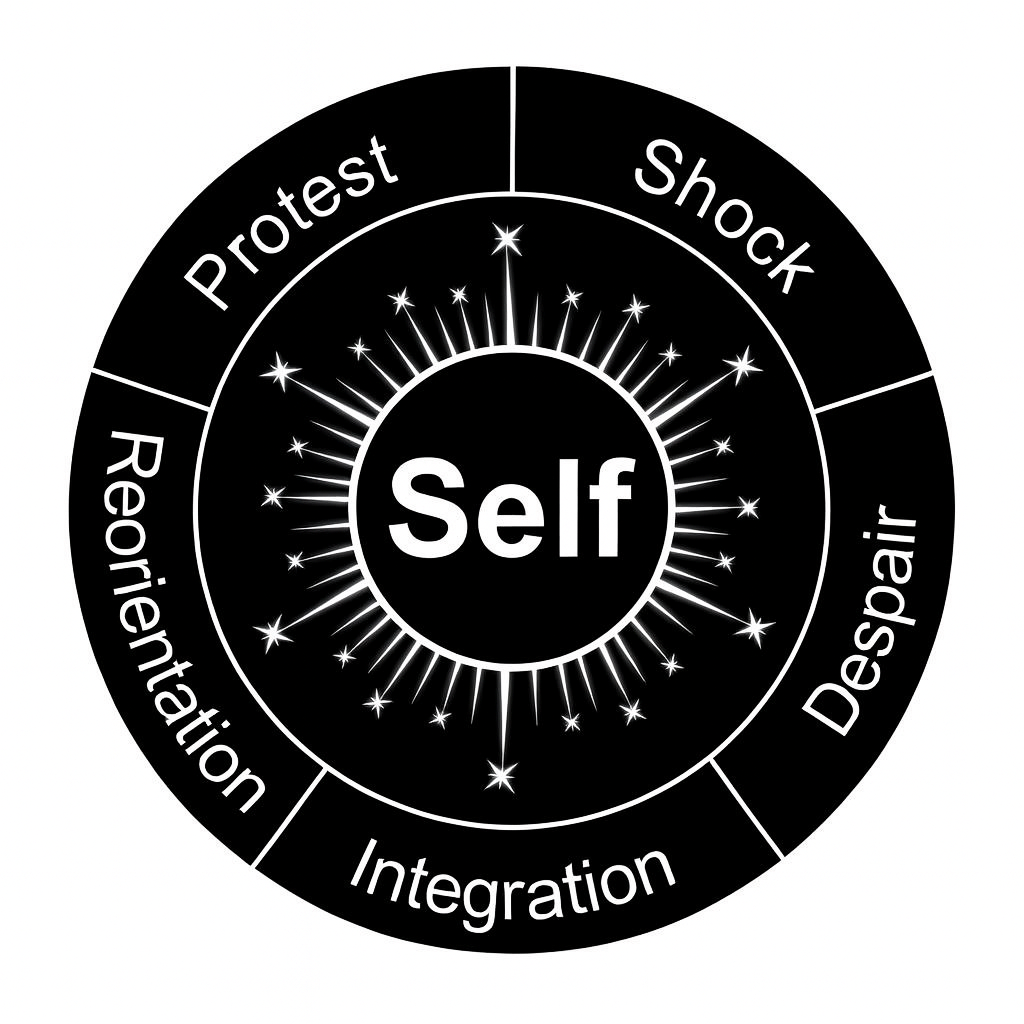
Circle of Grief
By Gregory Devore, Ph.D
Each sphere of grief stirs a different ache that’s missing: safety, acknowledgement, understanding, comfort, clarity, or space - and wakes up different reactions in our bodies. Sometimes we freeze, sometimes we fight, sometimes we just cry. Understanding where we are on the map helps us know what we’re longing for.
This model doesn't promise to end grief. Instead, it helps us understand it better - to notice which need is aching, which part of us is active, and what it might look like to honor and praise what was lost as we begin to make it a part of our lives.
The Circle of Grief: A Map for Love and Loss
Grief rarely moves in a straight line. It circles back. It rises and falls like waves, sometimes gentle, sometimes crashing. One moment you’re numb, the next you’re furious, the next you’re tenderly remembering a laugh you thought you’d forgotten. This isn’t a sign you’re “doing it wrong.” It’s how love metabolizes loss.
To honor this reality, I’ve mapped five recurring spheres of grief we often transit through: Shock, Protest, Despair, Reorientation, and Integration. Rather than steps to check off, they are landscapes we visit - sometimes several in a single day, or sometimes just one over years.
By noticing which sphere you’re in, you can begin to understand what your body is signaling and which unmet need is aching for attention. This awareness shifts grief from something that feels chaotic or endless into something you can tend to - a map you can navigate rather than a storm you’re lost inside.
At the center is something unbroken: the leadership of Self. The Self is never lost. It waits patiently with calm, curiosity, and compassion, able to hold every sphere of the circle with gentle strength. When grief feels chaotic, even noticing a single thread of Self - one breath of calm, one flicker of curiosity - is enough to begin re‑centering and guiding the system back toward healing.
The Five Spheres of Grief: Examples Beyond Bereavement
This model applies to all forms of meaningful loss, not just the death of a loved one:
Shock: The Shattering
Need stirred: Safety
Body state: Frozen, numb, running on autopilot
Emotional tone: “This can’t be real.”
Shock is often the first wave after loss. It hits like silence after a loud crash - everything feels surreal. Your body may go cold or still, your thoughts fuzzy, like walking through fog. This isn’t weakness; it’s your system’s emergency brake, a built‑in shield against overwhelm. These are protector parts working overtime.
Protest: The Cry
Need stirred: Acknowledgment and Understanding
Body state: Revved up, restless, seeking answers
Emotional tone: “This isn’t fair.” “Please, someone see this.”
Protest is the cry of love refusing to let go - think energy, fight, and outrage. It can sound like anger, bargaining, or questioning - anything to bridge the unbearable gap between what was and what is. Often people look for someone to blame, blame themselves, or look for something to change. Beneath every protest is longing: a yearning for what mattered most to be named, validated, remembered.
Despair: The Hollowing
Need stirred: Comfort and Clarity
Body state: Heavy, collapsed, hollow
Emotional tone: “I don’t know how to go on.”
When the fight ebbs, despair often follows - think numbness, collapse, depression. Comfort feels distant; the world loses its color. This is the ache of absence at its deepest - a quiet weight in the chest, a sense of being untethered. The meaning of the loss is felt, but not yet truly known. Despair asks not for fixing, but for gentle presence and compassion.
Reorientation: The Turning
Need stirred: Understanding and Space
Body state: Softening, tentative curiosity, hope, small breaths of relief
Emotional tone: “Maybe I can find my footing again.”
Reorientation is the slow return to movement with curiosity and some hope. Understanding the meaning and depth of the loss begins to take shape. This opens up new doors of possibility. We start to remember who we are outside the loss, to gently test what life feels like now. Space opens - not because grief has ended, but because we’re learning to carry it differently. Creativity, desire for connection, and feelings of play start to re-emerge.
Integration: The Weaving
Need stirred: All needs in balance
Body state: Steady, open, connected
Emotional tone: “This love is part of me now.”
Integration doesn’t mean the ache vanishes; it means love and loss find a way to live together. We honor what was through memory, ritual, and praise - planting a tree, telling stories, carrying forward what mattered. Grief becomes less about “moving on” and more about moving with; not forgotten - grown around.
Here’s a table that shows the relationship between each sphere and felt experience:
| Sphere | Unmet Need(s) Stirred | Body State | What It Feels Like |
|---|---|---|---|
| Shock | Safety | Frozen, numb, autopilot | “This can’t be real.” |
| Protest | Acknowledgment, Understanding | Restless, revved up, scanning | “This isn’t fair - please notice.” |
| Despair | Comfort, Clarity | Heavy, collapsed, hollow | “I don’t know how to go on.” |
| Reorientation | Understanding, Space | Softening, tentative, curious | “Maybe I can find footing again.” |
| Integration | All needs balanced | Steady, open, connected | “This love is part of me now.” |
These spheres show how grief touches nearly every corner of life and reveals a different texture of loss: the shock of sudden change, the protest of unmet expectations, the despair of hollow emptiness, the tentative reorientation toward new meaning, and the integration of love carried forward. Here’s Isabel’s story to illustrate the process:
When Isabel’s chronic illness first flared, she felt the ground drop out from under her. One day she was training for a half-marathon; the next she was staring at test results, stunned, unable to process the doctor’s words. Shock arrived first - the numbness, the disbelief. This can’t be real. There must be a mistake.
Weeks later, as the reality set in, the Protest rose up. Anger pulsed through her chest. Why me? I’ve done everything right. She scoured the internet for alternative treatments, fought with her insurance, bargained with the universe for her old life back.
But even as she cycled through anger, the Shock would return in quiet moments - scrolling through old race photos, suddenly remembering how different life once felt.
In time, exhaustion settled into Despair - hollow evenings when she couldn’t get off the couch, the shame of canceling plans again, the quiet grief of watching friends run races she could no longer join. Some mornings, she would lift briefly into Reorientation - joining an online support group or experimenting with gentle yoga - only to crash back into Protest the next day when her symptoms flared again.
Over months and years, Isabel learned that grief wasn’t something to finish, but a circle she carried inside her. At times she lived in Integration, channeling her love for movement into advocacy work and mentoring others. Yet anniversaries or sudden flare-ups would draw her back into earlier spheres, revisiting familiar aches - this time with more presence of the Self: compassion, care, and a steadier center.
The ache never disappeared. But it became softer, more reverent - grief and praise woven together, guiding her back to herself each time she circled through.
Knowing the spheres is only part of the picture. To navigate them, we need to understand why they feel the way they do - what specific needs are aching beneath each one. When safety shatters, when acknowledgment is missing, or when comfort and clarity feel out of reach, our nervous system responds in predictable ways. By mapping these needs onto the circle of grief, we can begin to meet them with the compassion, presence, and praise of the Self.
Attachment Needs in Each Sphere
Shock: Safety is shattered; the body freezes or goes numb (dorsal vagal), struggling to take in reality. Your body’s built‑in survival response that temporarily shields you from the full weight of what’s happening.
Protest: Acknowledgment and Understanding is sought. The ache breaks open into a cry: This isn’t fair. This can’t be true. We long for someone to notice, to validate what’s been lost, to help us make sense of it. Protest can sound like anger, bargaining, or desperate questioning. Underneath, it’s love calling out for what mattered most.
Despair: When the fight drains out, we sink. Comfort feels far away, and clarity blurs. Sadness, shame, or hollow hopelessness settle in like heavy weather. It’s the quiet ache of knowing life won’t go back to how it was - and wondering who we are in its absence.
Reorientation: Slowly, almost imperceptibly, the fog begins to lift in small moments. A breath comes easier. We start to reflect and find understanding in bits of meaning, tentatively exploring what life might look like now. Space opens - not because the ache is gone, but because we’re learning how to carry it differently.
Integration: Over time, love and loss weave together. The ache remains but softens. We remember, honor, and praise what mattered - planting trees, telling stories, carrying forward pieces of what we loved. Grief becomes part of our story, not the whole of it.
Infusing Praise Through the Circle
Praise is not reserved for the end of grief. It threads through the entire circle:
In Shock
Whisper the simplest truth: This mattered. Even if words feel impossible, a quiet ritual - lighting a candle, holding a photo - anchors you to love amid the numbness, even if feelings are far away. The safety that was lost needs gentle acknowledgement, in any form.In Protest
Let the cry also be a tribute: I loved this enough to fight for it. Yell, journal, pray, or gather community to name what should not have been lost.In Despair
Sit gently with the hollow and honor its sacredness: This absence hurts because the presence was beautiful. Tears become praise; quiet becomes reverence.In Reorientation
Storytelling begins: remembering shared jokes, favorite places, small kindnesses. Praise shifts toward meaning-making - how what we loved still shapes us.In Integration
Rituals emerge - planting, cooking, visiting sacred spots - not to hold on, but to carry forward. Praise weaves loss into life, so love lives on.
Returning to Isabel - years later when her father died, she drew on what she had learned from grieving her chronic illness - the practice of letting praise coexist with pain. Rather than waiting to “get through” grief, she allowed praise to surface in small ways at every sphere:
In Shock, she lit a candle each night, whispering, He mattered - a quiet ritual when nothing else made sense.
In Protest, she slammed cupboards and shouted at the sky, but beneath the anger she praised her devotion: I miss him, I wanted more time.
In Despair, she sat quietly in his favorite recliner, tears falling as she murmured, His absence is sacred because his presence was sacred.
In Reorientation, she began sharing stories with her nieces - about his stubborn humor, his garden, the way he danced while cooking - finding beauty in what remained.
In Integration, she planted sunflowers in his memory each spring, a ritual of gratitude that carried him forward into her own life.
Rituals of Praise and Presence
Rituals don’t have to be grand or religious - they’re simply repeated acts that give shape to meaning. They anchor us when grief feels chaotic. Here are a few simple ones to begin:
Light a candle daily for someone or something lost, whispering, “You mattered.”
Create a memory jar: write one memory at a time and place it inside; revisit on anniversaries.
Plant something living - a tree, flowers, or herbs - as a symbol of love carried forward.
Cook or share their favorite meal, letting taste and smell evoke connection.
Write letters you’ll never send, giving your ache a voice and your love a landing place.
Praise doesn’t end the ache, but it steadies us - giving us touchpoints to return to each time we transit back through a sphere of grief.
Where We Get Stuck
Even when we understand the circle of grief, we don’t always move through it fluidly. Some spheres feel harder to leave than others. We loop back, linger, or feel paralyzed - not because we’re “doing grief wrong,” but because certain attachment needs remain unmet or praise hasn’t yet found a way to flow. Recognizing these stuck points can turn self-criticism into compassion and point us toward healing.
Overidentifying with the Loss
One common place of stuckness is identity: when the loss feels inseparable from who we are.
Who am I if I’m not their spouse?
If I can’t work in this field anymore, do I even matter?
Without this community, where do I belong?
When our sense of self was woven into the bond - as parent, partner, leader, caregiver, or believer - its severing can feel like losing ourselves. In these moments, grief isn’t just about absence; it’s about searching for identity and worth. We may cling to memories or resist moving forward, fearing it means losing the last thread of who we were.
Shame in Grief
Another place we get stuck is in minimizing our own pain - believing certain losses “shouldn’t” hurt this much.
Why does this breakup still ache?
Why am I grieving this job like someone died?
Shouldn’t I be over this by now?
Cultural narratives often prioritize death-related grief while dismissing losses of dreams, roles, health, or belonging. But the nervous system doesn’t distinguish between “valid” and “invalid” loss - it responds to rupture, period. When we judge our own ache, shame compounds the pain and blocks praise from flowing: If this doesn’t count, I can’t honor what it meant to me. Truth is, if you feel it, your ache is real.
Disenfranchised or Unseen Grief
We also get stuck when grief is ignored or invalidated by others. This is disenfranchised grief - when society, family, or community doesn’t recognize the depth of our loss.
The quiet devastation of infertility.
The pain of estrangement from a living parent.
The isolation of grieving a friend others barely knew.
When grief is invisible, we often carry it alone. Without communal acknowledgment, attachment needs for safety and recognition remain unmet, making the ache heavier and harder to metabolize.
Reframing Stuckness
In all these places, stuckness is not failure. It’s feedback. It signals an unmet need - for safety, acknowledgment, understanding, clarity, comfort, or space - and an invitation to find praise even here. Rather than pushing ourselves to “move on,” we can ask:
Which need (safety, acknowledgement, clarity, understanding, comfort, space) feels most unmet right now?
What does this ache say about what mattered?
Is there a way to honor what I loved - through ritual, memory, story - so it can be carried instead of erased?
Let’s explore the story of Eli and his stuck point:
Eli dedicated his life to his startup, but after uncontrollable market conditions changed it collapsed. He expected disappointment - but not the emptiness that followed. For months, he woke up with the same thought: Who am I if I’m not building this company? The loss wasn’t just financial; it was identity, purpose, and belonging.
He found himself stuck in despair, cycling between shame (“I failed”) and numbness. Friends tried to cheer him up - You’ll bounce back - but their words made him feel even more unseen. What he needed was acknowledgment and understanding: someone to name how much he had poured into that dream, and how devastating it was to watch it unravel.
Eventually, Eli began a quiet practice of praise - not of the failure, but of what the dream had meant to him. Each night, he wrote down one thing he had loved about building the company: the creativity, the teamwork, the courage it took to try. Slowly, this softened the shame. The loss still ached, but it no longer felt like proof he was broken. It became part of his story - something he could honor and carry forward.
Naming where we’re stuck transforms shame into curiosity. It turns grief from a solitary burden into a path back toward Self - not by rushing through the circle, but by meeting each return with deeper compassion.
Navigating the Circle
You will likely return to these spheres many times. An anniversary may pull you back into Protest; a smell may thrust you into Shock. This does not mean you are “failing” or “backsliding.” It means your nervous system is continuing its work - revisiting needs, offering opportunities to tend them more deeply, and carrying love into new layers of meaning.
Naming where we’re stuck is the first act of compassion - it shifts the question from “What’s wrong with me?” to “What is this loss asking for?” Grief stops feeling like failure and begins to reveal unmet needs waiting to be honored. As you keep circling back - to Shock, Protest, or Despair - you can meet each return with curiosity rather than shame, and praise the love beneath the ache.
In the workbook that accompanies this book, you’ll find guided practices to help with exactly this - exercises for recognizing stuck points, identifying the needs they reveal, and creating small rituals of praise to carry what mattered forward. If you’re ready, pause here and explore those prompts before moving on; they’re designed to deepen what you’ve just read and make the circle feel more lived-in than theoretical.
Where This Map Comes From: Building on What We Know
This circular grief model isn't a brand new idea out of nowhere. It brings together important ideas from many smart people and ancient traditions. While the five 'spheres' (Shock, Protest, Despair, Reorientation, and Integration) are a new way to put things together, each part builds on strong research:
How We Connect (Attachment): Back in the 1980s, a researcher named Bowlby studied how people react when they're separated from loved ones. He noticed people often went through phases of protesting, feeling sad and hopeless, and then detaching. This showed how our deep connections drive our grief.
Grief as a Dance, Not a Straight Line: Other ideas from the 1990s, like the Dual Process Model and Two-Track Model, helped us see grief less like a step-by-step ladder and more like a back-and-forth dance between focusing on the loss and trying to rebuild life. This challenged the old idea that grief just moved in a straight line.
Our Body's Role (Polyvagal Theory): More recent research helps us understand how our body's nervous system reacts to stress and sadness. It explains why we might sometimes feel a surge of energy and panic, sometimes feel completely shut down, and sometimes find a way to calm ourselves. These shifts are a big part of how grief feels in our body.
Our Inner 'Parts' (Internal Family Systems): This approach helps us recognize that we have different 'parts' inside us - like a part that protests, a part that feels numb, or parts that hold our deepest hurts. These 'parts' often show up in the ways we react to grief.
Grief and Praise as One: The powerful idea that grief and praise are truly inseparable, and that finding meaning in loss is key, comes from the ancient wisdom of people like Martin Prechtel. His work on ritual and communal grieving reminds us how important it is to honor what we've lost.
By weaving all these different threads together, this circular model offers a fresh way to understand grief. It's a never-ending process of honoring our needs and finding ways to integrate the love and meaning from all kinds of losses - whether it's people, parts of our identity, roles we used to play, or even dreams we had.
Collective Grief
Grief lives in more than individuals; it reverberates through families, communities, and entire cultures. Sometimes we ache not only for personal losses but for collective ones - the world we thought we lived in, the safety we assumed we had, or the shared values we believed were unshakable.
Forms of Collective Grief
Climate grief: The sorrow of watching landscapes we love - forests, coastlines, ecosystems - disappear or change beyond recognition. The grief of knowing future generations may never experience them as we have.
Pandemic grief: The collective mourning of lives lost, rituals disrupted, and the invisible ache for what daily life was before. Even though the crisis has faded from headlines, its impact lingers in our bodies and communities.
Cultural dislocation: The ache of migration, diaspora, or losing connection to ancestral lands and traditions. This includes the grief of assimilation - parts of self or culture left behind to survive elsewhere.
Racial and historical trauma: Generational grief carried by marginalized communities whose losses - through violence, oppression, or erasure - often go unacknowledged. This includes the unspoken ache of histories never mourned collectively, leaving wounds unhealed.
The Role of Collective Rituals
When we share our losses with others, rituals become a way for us all to praise what was lost together. Think of the candlelight vigils held after the 9/11 attacks, where people gathered in cities worldwide, holding candles and sharing a quiet moment of sorrow and remembrance. Or the planting of community gardens in places once devastated by natural disasters, like those seen in areas recovering from hurricanes or wildfires. These aren't just symbolic gestures. They actually help calm everyone's feelings, show what we all care about, and create a safe space for us to acknowledge what happened.
In these shared moments, your personal pain connects with everyone else's, turning any feelings of being alone into a sense of belonging. These acts send a clear message: We will remember. We will honor. We will carry forward together.
The Need for Permission
Many cultures - especially Western ones—make it hard for people to grieve openly, especially for losses that aren't about someone dying. We often get praised for "being strong" or "moving on" quickly, even when a shared pain or trauma is still simmering beneath the surface. For example, think about how people struggled to openly grieve the loss of routines and normal life during the COVID-19 pandemic, or the collective shock and sadness after a natural disaster like Hurricane Katrina, where communities lost homes, schools, and their entire way of life. Without everyone acknowledging these losses together, our basic human needs for safety and belonging aren't met, and it becomes much harder for our grief to truly heal.
Creating "cultural permission" means we need to say that all forms of loss are valid - not just when someone passes away. It means allowing communities to openly name what's been broken, mourn it together, and also praise what was beautiful about what was lost. This shared naming can turn big community wounds into chances for healing and togetherness.
Why This Matters in the Circle
The circle of grief applies as much to communities as to individuals. Communities cycle through Shock after collective tragedy, Protest in marches and demands for justice, Despair in quiet moments of hopelessness, Reorientation when envisioning new futures, and Integration in rituals that honor the past while moving forward.
Praise at this level - cultural praise - is powerful. It reminds us that love and longing are not just personal but shared, echoing through generations and shaping the stories we pass on.
Consider these historical examples:
Shock & Protest: After the assassination of Dr. Martin Luther King Jr. in 1968, many communities across the United States experienced immediate shock and profound sadness. This quickly led to widespread protest, with marches and civil unrest erupting as people grieved the loss of a leader and demanded an end to systemic injustice.
Despair & Reorientation: Following the devastating Dust Bowl era in the 1930s, many communities in the American Great Plains faced immense despair as their farmlands turned to dust, forcing mass migrations. Yet, in the aftermath, communities that remained, and those that formed elsewhere, began a process of reorientation, developing new farming techniques, conservation efforts, and strengthening social ties to adapt to a changed landscape and future.
Integration: The annual Dia de los Muertos (Day of the Dead) celebrations in Mexico are a powerful example of community integration. Families and communities come together to honor and remember their deceased loved ones, creating altars with their favorite foods and drinks, sharing stories, and participating in parades. This vibrant ritual openly acknowledges the pain of absence (grief) while simultaneously celebrating the lives lived and the enduring connections (praise), weaving the past seamlessly into the present.
These collective experiences show how communities, like individuals, move through the spheres of grief, finding ways to honor what was lost and build pathways toward a shared future.
From Absence to Reverence
Think about it: to live is to love - and to love is to grieve, and to praise. Every single ache we feel when something is lost is powerful proof. It's evidence that something truly mattered, something that shaped us into who we are. Grief isn't a sign of weakness or that something's wrong with you. It's simply your body's deeply human way of holding onto love when the person, dream, or way of life it was attached to has changed or moved on. The very cost of connection is also the beautiful proof that we were alive enough to care deeply, to attach, and to truly belong.
It’s vital to remember that instead of grief as a straight line to “get over,” it’s more like a circle, with different spheres we revisit. Just like we explored, in time, grief doesn't just disappear. Instead, it begins to transform. The absence of what's gone remains, yes, but so does the powerful love. We learn to carry both these truths. We learn to tell the stories of what was, to create rituals that honor the sacred moments, and to praise what was beautiful - all without needing to erase the ache that comes with it. This journey isn't about forgetting; it's about remembering differently, weaving the past into the fabric of who we are now.
Here’s the deeper truth: praise in loss is how unmet attachment needs finally get met. When you honor what was lost - by naming it, remembering it, celebrating it - you’re offering acknowledgement to the parts that mattered. You’re giving clarity to what was meaningful, comfort to what still hurts, understanding to what once felt confusing, and safety and space to your own grief. In this way, praise is both sentimental and reparative. It transforms lonely pain into belonging, absence into reverence, and longing into integration.
This is also where we give ourselves, each other, and our communities permission to truly feel. To acknowledge that all losses matter, not just the ones society easily sees. When we do this, our individual ache connects to something bigger, transforming lonely pain into a sense of belonging.
So, picture the ocean again, that powerful metaphor for the waves of grief. The waves will still rise, but you'll find you're no longer just thrashing around, overwhelmed by the storm. Instead, you can learn to float - sometimes quietly, sometimes even singing. You'll be carried not just by the ache of what is gone, but by the powerful, enduring praise of what remains. This understanding is a gift you can carry into your own life, moving forward with both your heart and your memories.
The most beautiful people we have known are those who have known defeat, known suffering, known struggle, known loss, and have found their way out of the depths. These persons have an appreciation, a sensitivity, and an understanding of life that fills them with compassion, gentleness, and a deep loving concern. Beautiful people do not just happen." - Elisabeth Kübler-Ross
